Why Sound “Sad”?
When your heart aches and things seem heavy, but there’s still hope pulling you forward, that familiar, bittersweet sadness is often called “melancholy”, and it’s something many musicians love to capture in their playing.
For me it’s become one of my go-to vibes for improv sessions with family and friends. Just like having a reliable warmup routine or rhythm, having a go-to mood in your toolkit is a lifesaver. It’s especially useful when you’re put on the spot and forced to improvise “something” that people can connect with.
Sadness is instantly relatable. When people hear it in music, they easily recognize and empathize with it. Like a good song, that feeling of melancholy just hits different.
So, if you want to sound like some of your favourite sad songs, or create your own entirely, then keep reading. I’ll walk you through the “saddest” key in music and my go-to sad chord progressions for composing and improvising.
The Key (and Chord Progression):
D Minor scale/F Major (“Saddest” Key):
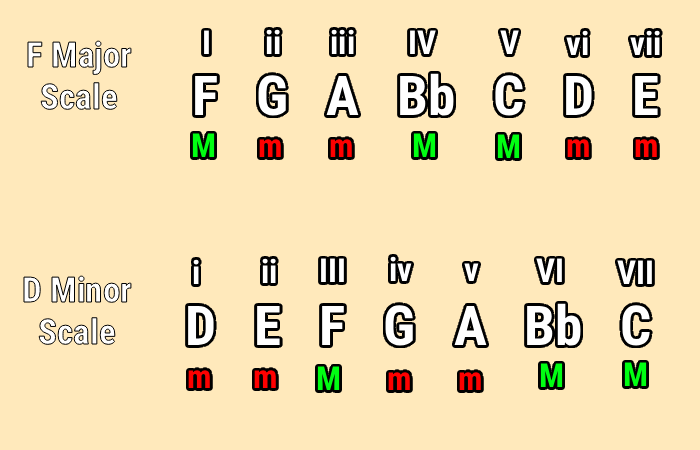
Like how an artist might choose a color palette for their painting, it’s important for musicians to pick a key, or group of notes, for their songs. Following that same logic, an artist also wouldn’t pick neon shades to create sorrowful pieces. Therefore, a musician shouldn’t use a bright scale for a dark song.
Often called the saddest key(s) in music, the D minor scale, with its relative F major scale (above), has a reputation for sounding dark, expressive, and nostalgic. Hans Zimmer, composer behind Interstellar (2014) and Gladiator (2000), has praised D minor for its dramatic and reflective qualities in his Masterclass workshop.
But if Hans Zimmer only speaks on D minor, then what does F major have to do with it? Aren’t they the same thing? Shouldn’t “major” mean an automatically happy sound? Put simply, they are the same thing but with different focus points. It’s all about the tonal center, or which note you treat as “home”. Like an artist choosing the main color of their painting, your tonal center helps set the overall mood.
So, when you’re playing, you’ll also need to decide which tonal center or color you want to emphasize in your song, D minor or F major. They may share notes, but they feel very different. F major will have a slightly more warm and nostalgic feel to it, while D minor is famous for feeling tragic and expressive.
However, most importantly, it’s how you use the notes within either key that really makes the audience connect and feel.
The Chord Progression:
When it comes to nailing that melancholy mood, this chord progression is bread and butter for me, and apparently quite a few popular artists/bands. It doesn’t have an official name, so I just call it “that one sad, pop-punk chord progression” or “The OG” for short.
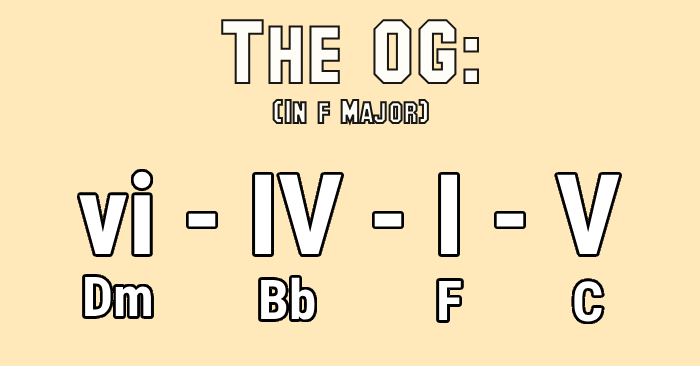
While in the key of F major, starting the progression with the minor sixth, or D minor, immediately evokes an unsettling feeling that must be resolved, which it does by changing to the perfect fourth, injecting hopefulness into the progression. But, it’s not fully resolved yet and tension is only released when it changes to the tonic, or home chord, before predictably rising to the fifth. In art, “predictable is comfortable” which is further exemplified in the feeling evoked by this chord change. Furthermore, as a tip, listeners can often predict where a progression is headed, and when it follows that, the listener feels satisfaction and connects with the piece.
Think I’m making things up? Besides adding their own twists, let me list you a few examples using almost exactly these techniques:
- “Go Flex” (2016) – Post Malone (F Major)
- “Pieces” (2004) – Sum 41 (F Major)
- “21” Guns (2009) – Green Day (F Major)
- “Little Dark Age” (2018) – MGMT (F# Minor)
- How To Save A Life (2005) – The Fray (Bb Major)
The Variations:
Relative Minor Key Version:
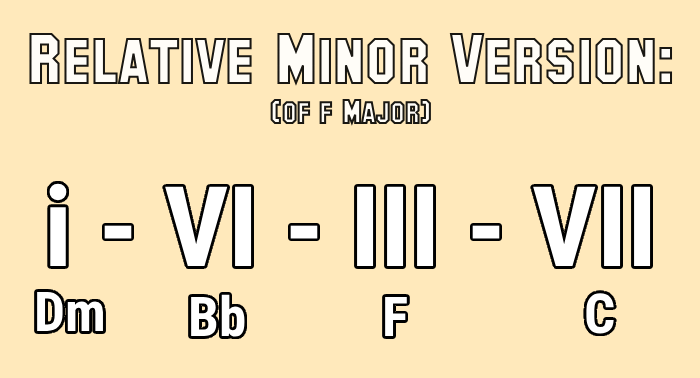
Choosing the minor key as the tonal center instead, you still get that feeling of longing and introspection, but it’s much more expressive and dramatic. In fact, if you use power chords (tonic, fifth) instead of triad chords (tonic, third, fifth), it actually sounds pretty rockin’ without being all bright and cheery. Some examples include:
- “Doctor Doctor” (1974) – UFO (D minor)
- “You’re Gonna Go Far, Kid” (2008) – The Offspring (A minor)
“Hey There Delilah” Version:
Who doesn’t feel a strong sense of nostalgia and a twinge in their heart when hearing this song?
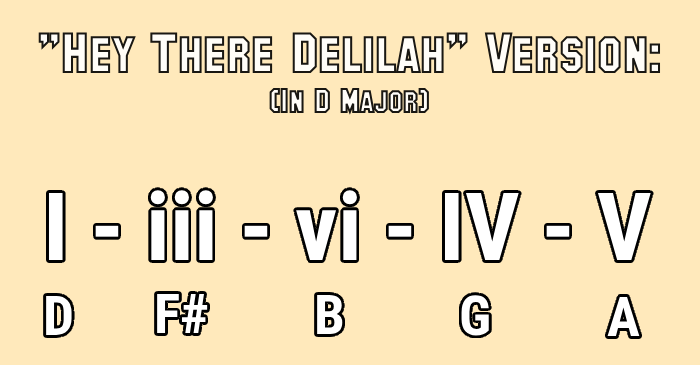
Unlike the original progression, “Hey There Delilah” shifts the position of the major tonic to be the first chord, which creates an upbeat feeling before throwing in a minor third and then changing to the minor sixth. The change between these chords passes over like a dark cloud on a sunny day, before being sunny again by changing to the fourth and then the fifth, building resolution. It then loops back to the major tonic, as if to make you question whether that somber feeling was even real or not.
How to Use These Chord Progressions:
While I do use these chord progressions as fallbacks, the creativity really starts by tweaking and modifying them. For example;
- Arpeggiate it
- Instead of playing each note of a chord together in harmony, play their individual notes like a melody. You get an instantly flowing and emotional line.
- Transpose to Different Keys
- Not all keys sound the same to everyone! Use the chord progression or a variation of it in a different key to add some spice!
- Drop D tuning (On Guitar)
- By tuning the low E string to a D, and playing in D minor, you can create a lot of ambience by simply playing over the sound of the open D string. In fact, if you’re a Tool fan, this is the quickest way to start sounding like them.
- Different rhythms
- Usually, slower is better, but not too slow. For example, “21 Guns” is only 76 BPM.
- Experiment with your own variations
- Start with the original progression and rearrange the order or add one chord and take away another.
- Create a melody over the chords
- As a guitarist I’ll often record a chord progression in a looper pedal and then play lead over it. An added tip is that if you record the progression in a minor key, try playing in the relative major key overtop, and vice versa.
- Different instruments for different moods
- While I primarily play electric guitar, you don’t always need a sledgehammer for every job. Changing up your tool or instrument can have a dramatic effect on the mood of the music.
In conclusion, while D minor is popularly called the saddest key, the most important thing is how you use it, and the above “sad” chord progressions are easy formulas for heartache. If I’ve missed anything, let me know with a comment below.